
Skip to content

Cart

Your cart is empty

Plugin solar in Latvia

Can I use a plug-in solar kit in Latvia? Not simply by plugging it in. Latvia has no specific rules for plug-in or balcony solar, and no watt limit for self-installed kits. Any solar system that runs in parallel with the grid counts as a "microgenerator". It needs written permission from the grid operator, Sadales tīkls, before you switch it on. A certified installer must fit the system and set up the inverter, and the inverter must be on Sadales tīkls' approved list. In April 2026 the Climate and Energy Ministry said it opposes connecting such devices without the operator's permission. A small kit can still be used legally through this standard route.

General overview for Latvia

Plugin solar kits: None set

There is no plug-in category in Latvia. A kit plugged into a socket without permission isn't covered by any rule, and the Climate and Energy Ministry warns that a socket is not designed as a feed-in point. To use a kit legally, treat it as a microgenerator. Apply to Sadales tīkls, have a certified installer connect it behind a breaker of 16 A or less, and wait for written permission.

Other solar kits

Larger kits follow the same microgenerator route, up to 16 A per phase. That is about 3.7 kW on a single-phase connection or 11.1 kW on a three-phase one. Above 11.1 kW, a system counts as a power plant and follows a separate procedure. Panels on the façade, balcony or roof of an apartment block usually need the co-owners' consent and may need the municipal building board's approval.

Feed-in compensation

Yes, once Sadales tīkls has given permission. New producers can no longer join the old kWh-for-kWh net metering, which closed to new members on 30 April 2024; existing users keep it until 28 February 2029. Instead you sign a net-settlement contract with your electricity supplier, who credits your surplus in euros at the price in your contract. Most homes already have a smart meter that records both directions.

The legal basis for plugin solar in Latvia

Latvia has no law or regulation on plug-in solar. Small generators fall under the general rules for "microgenerators", meaning systems up to 11.1 kW. The Electricity Market Law (Elektroenerģijas tirgus likums) sets the rules for active users, net metering and net settlement.

The grid operator Sadales tīkls publishes general technical requirements for microgenerator connection. They require:

  • connection to the home's internal wiring through a breaker of no more than 16 A;
  • an inverter that meets LVS EN 50549-1:2019, the national grid code and EU Regulation 2016/631;
  • installation and inverter setup by a certified building specialist;
  • written permission before the system runs in parallel with the grid.

Product safety is supervised by the Consumer Rights Protection Centre (PTAC). On 28 April 2026 the Climate and Energy Ministry (KEM) said it welcomes simple, user-friendly devices but opposes connecting them without the operator's permission, because this can endanger other users and the grid. We found no Latvian announcement following the EU Commission's Recommendation of 30 April 2026 on balcony solar up to 800 W. This page is guidance, not legal advice.

Certification and registration requirements in Latvia

There is no separate registry for small kits. Everything goes through Sadales tīkls' customer portal, e-st.lv:

  1. Apply for a microgenerator connection and name your inverter. It must be on Sadales tīkls' list of approved inverters.
  2. Pay the assessment fee: €81.29 including VAT, per the price list checked on 9 November 2026.
  3. Have a certified building specialist install the system and sign the inverter settings protocol. The specialist must be certified for power plants and generation equipment.
  4. Within nine months, upload the confirmation, the protocol, the specialist's certificate, and photos of the inverter nameplate and the installation.
  5. Switch on only after you receive written permission.

The whole process usually takes one to two months. If you later change the inverter or its settings without approval, Sadales tīkls can require you to disconnect. Products must carry the CE mark and meet EU electrical safety rules.

How to handle your utility in Latvia

Your grid operator is almost always Sadales tīkls. A few areas are served by other operators, such as Latvian Railways' network, which runs a similar process.

Before choosing a kit, check your connection data (number of phases, main breaker) in e-st.lv. Sadales tīkls usually confirms within a few working days whether your connection can take the generator. In rare cases grid works are needed, at your cost.

If you live in an apartment block and want panels on the façade, balcony or roof, get the co-owners' agreement and check with the municipal building board first. Riga has fined residents for unauthorised panels on façades and balconies.

To be paid for surplus, sign a net-settlement contract with your electricity supplier. Every supplier must offer a universal net-settlement service. A fully off-grid system, not connected to your home wiring, doesn't need Sadales tīkls' permission.

Are there any incentives for plugin solar in Latvia?

Latvia's household renewable-energy programme is run by the Environmental Investment Fund (VIF) under Cabinet Regulation No. 531, in force since 12 September 2026. It pays:

  • up to €700 for a solar system under 1 kW, covering up to 70% of costs (85% for Latvian Honour Family card holders);
  • up to €2,500 for a battery of at least 10 kWh.

You apply after installation. Conditions include a Sadales tīkls permit, at least 80% self-consumption, installation at the property where your home is, and equipment bought from a company registered in Latvia. The programme runs until 2029 or until funds run out. Standard VAT of 21% applies, with no reduced rate for solar.

Contribute to this overview

While we researched each country's regulation diligently, we might have missed a recent update or got something wrong. If you have more updated information, please contribute to this overview and message us.

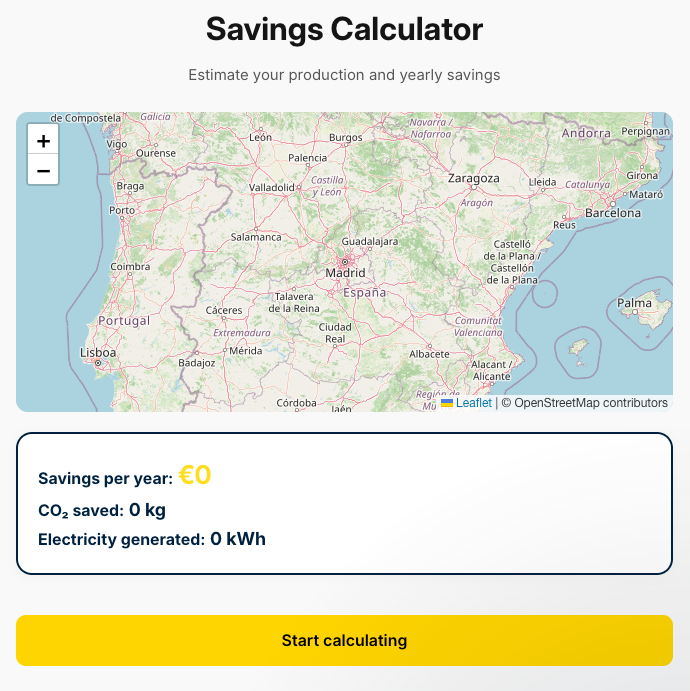
Savings Calculator

Estimate your production and yearly savings

Savings per year: €0

CO₂ saved: 0 kg

Electricity generated: 0 kWh

Find your Robinsun solar kit

Where will you install it?

Choose the mounting location for your kit.

How many panels?

Pick the kit size that fits your needs.

Disclaimer: In Spain, outputs above 800 W require grid certification (CIE) to export surplus. We can handle it for you.