Skip to content

Cart

Your cart is empty

Plugin solar in Switzerland

Yes. Switzerland has allowed plug-in solar kits since 2014, under a notice from the Federal Inspectorate for Heavy Current Installations (ESTI). You can plug a complete kit with up to 600 W of inverter output into an ordinary outdoor socket, without an electrician. The kit needs a Swiss plug, a residual-current safety device and a declaration of conformity for the whole kit. The 600 W limit applies per electricity meter, not per socket. Before you switch the kit on, tell your local grid operator in writing. Tenants need their landlord's permission. Surplus power fed into the grid is paid for. A move to 800 W is being studied but has not been decided.

General overview for Switzerland

Plugin solar kits: 600 W

Allowed. The inverter's rated AC output may never exceed 600 W, counted across all plug-in kits on one meter. Panels may have more DC power as long as the inverter caps output at 600 W. The kit must have a Swiss plug (type 12, 13 or 23, standard SN SEV 1011) and either a 30 mA type B residual-current device in the cable or plug, or a monitoring unit (RCMU) built into the inverter.

Other solar kits

Systems above 600 W, or any system wired into the fuse box, count as fixed installations. A company with an installation permit under the Low-Voltage Installations Ordinance (NIV) must install them on a separately protected circuit (NIN chapter 7.12). The installer handles the grid operator's connection request and the safety certificate. Systems of 2 kW or more fixed to a building can get the federal one-off subsidy from Pronovo.

Feed-in compensation

Yes. Grid operators must take and pay for surplus solar power, including from plug-in kits (Energy Act, Art. 15). In 2026 the payment follows the quarterly reference market price, with a federal minimum of 6 Rp./kWh for systems below 30 kW. If you don't have a two-way smart meter, the operator may pay a flat annual amount instead. Ask your operator about meter changes and any costs.

The legal basis for plugin solar in Switzerland

The rule is the ESTI notice “Plug-&-Play-Photovoltaikanlagen” (Bulletin 7/2014). It treats a plug-in kit as a low-voltage product under the Low-Voltage Products Ordinance (NEV, SR 734.26), not as an electrical installation. The notice sets out:

  • Per supply line (in practice, per meter), plug-in kits may total at most 600 W of rated AC output, plugged into 230 V outdoor sockets such as on a balcony or roof terrace. The output may never exceed 600 W.
  • Panel, inverter, any battery and the grid connection must form one unit, with a Swiss plug and a residual-current device.
  • The instructions must tell the user to notify the grid operator in writing before first use.
  • Systems above 600 W may not go on final circuits. They must be fixed-wired by a licensed installer under the NIV.

The installation standard NIN 2025 (in force 1 January 2025) confirms that plug-in PV systems are products outside its scope and that a Swiss guideline will follow. A federally funded study (BFH, final report 28 February 2026) recommends 800 W single-phase and 2,400 W three-phase limits, plus rules for batteries. A working group of technical committee TK 82 has been drafting the guideline since spring 2026. Until it is published, the 2014 rules apply unchanged. Swiss retailers and grid operators read “rated output” as the inverter's nameplate, so an 800 W inverter limited by app is generally not accepted. This page is guidance, not legal advice.

Certification and registration requirements in Switzerland

The whole kit must come with a declaration of conformity that lists all relevant standards under the NEV. You send it to your grid operator with your notice and must be able to show it at an inspection. The kit must also have either a type B 30 mA residual-current device in the cable or plug, or a residual-current monitoring unit (RCMU) built into the inverter, and you must be able to prove this. The Swiss plug must be part of the kit: a kit with a foreign plug and an adapter does not meet the rule. Outdoor extension cables need IP55 connectors.

There is no national register. You only notify your grid operator (see next section).

Other permissions:

  • Tenants need the landlord's consent before installing. Put it in writing; written consent is mandatory if the kit involves structural changes (Art. 260a Code of Obligations).
  • Condominiums: panels on balcony exteriors or façades need the owners' meeting to approve by qualified majority.
  • Building permit: rarely needed inside building zones, but it can be for protected buildings or areas. Ask your municipality or canton.

Batteries are only covered by the 2014 notice if they are part of the kit itself. Separately plugged-in batteries are not specifically regulated yet. More in the EnergieSchweiz FAQ.

How to handle your utility in Switzerland

Switzerland has several hundred local grid operators (for example EKZ, ewz, BKW, CKW, Groupe E, Romande Energie and IWB). Your operator is the company named on your electricity bill.

  1. Before switching on, notify the operator in writing. Most accept an email; larger operators have an online form. Give the manufacturer, model and power of the kit, and attach the declaration of conformity and the data sheets.
  2. Check your meter. The operator may install a two-way smart meter to measure what you export. If it doesn't, it can pay you a flat annual amount for your surplus. Ask whether a meter change costs anything.
  3. Check the payment. Compensation follows the operator's published feed-in tariff, which must meet the federal minimum (6 Rp./kWh in 2026 for systems below 30 kW).
  4. If you remove or move the kit, tell the operator, so its records stay correct.

Are there any incentives for plugin solar in Switzerland?

There is no federal subsidy for plug-in kits: Pronovo's one-off payment needs at least 2 kW of panels fixed to a building. Some cantons, municipalities and grid operators do subsidise kits; search energiefranken.ch by postcode. Buying a kit is normally not tax-deductible, but tax rules are cantonal, so ask your local tax office. Standard Swiss VAT of 8.1% applies.

Contribute to this overview

While we researched each country's regulation diligently, we might have missed a recent update or got something wrong. If you have more updated information, please contribute to this overview and message us.

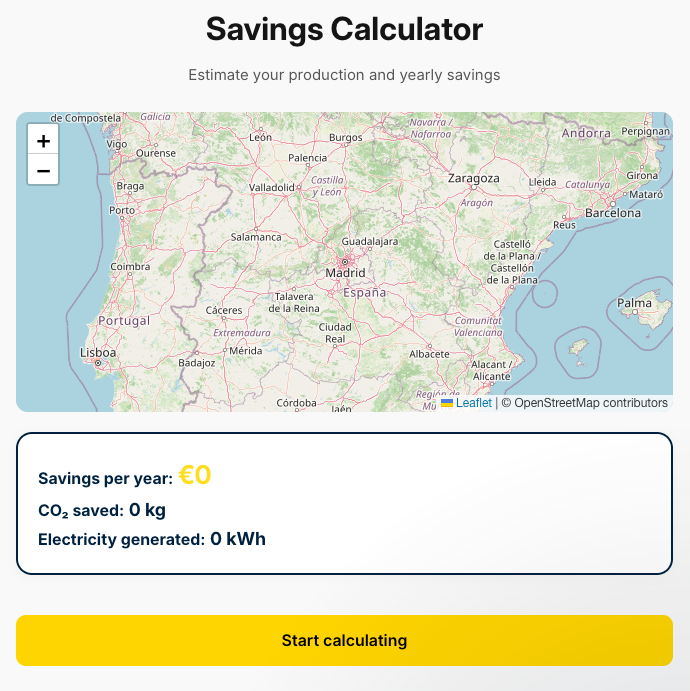
Savings Calculator

Estimate your production and yearly savings

Savings per year: €0

CO₂ saved: 0 kg

Electricity generated: 0 kWh

Find your Robinsun solar kit

Where will you install it?

Choose the mounting location for your kit.

How many panels?

Pick the kit size that fits your needs.

Disclaimer: In Spain, outputs above 800 W require grid certification (CIE) to export surplus. We can handle it for you.