Skip to content

Cart

Your cart is empty

Plugin solar in Malta

Can I use a plug-in solar kit in Malta? Not as a plug-and-play device, as things stand. Malta has no specific rules for plug-in or balcony solar and no simplified watt limit, so a kit is treated like any other solar PV system. It must be notified to the Regulator for Energy and Water Services (REWS). Malta's wiring rules follow BS 7671, which requires a generator to be connected on its own circuit at the fuse board, not through a socket, and an authorised electrician must do and certify the work. In return, small systems usually need no planning permit, no grid study and no fee. Enemalta fits a meter, and you may earn a feed-in tariff or a government grant. This page explains the rules and the steps.

General overview for Malta

Plugin solar kits: None set

Malta has no plug-in category and no 800 W limit. The Electrical Installations Regulations require every installation to follow BS 7671. BS 7671 says a generator must connect on the supply side of the final-circuit protective devices, so plugging a kit into an ordinary socket does not comply. In practice, treat a kit as a small standard PV system.

Other solar kits

Systems up to 16 A per phase need only a notification to REWS, with no fee and no prior grid study. That is 3.68 kW single-phase or 11.04 kW three-phase (20 A with volt-var control). Larger systems need REWS authorisation, an Enemalta grid study and a generation licence. An authorised electrician installs and certifies the wiring, and a warranted electrical engineer signs off the technical details.

Feed-in compensation

Yes, surplus can be paid. Enemalta fits a PV meter. Without a grant, systems below 40 kWp can apply for €0.15/kWh for 20 years (first come, first served). Grant-aided systems get a lower tariff. Alternatively, you can self-consume and sell the surplus at a market-price proxy. Tariff payments are capped at kWp × 1,600 kWh a year.

The legal basis for plugin solar in Malta

  • Electricity Regulations (S.L. 545.34): every generating station must comply. Up to 16 A per phase (20 A with volt-var control), it must be notified to REWS; above that, it needs a REWS authorisation before building and a generation licence afterwards. Fines go up to €69,000.
  • Electrical Installations Regulations (S.L. 545.24), in force since 2010 and last amended by Legal Notice 283 of 2024 (29 October 2024): installations must follow the latest BS 7671; only REWS-authorised electricians (Authorisation A or B) may install, alter and certify; grid-connected generators must meet the Network Code and have anti-islanding protection.
  • BS 7671, regulation 551.7: requires generators on the supply side of final-circuit protection. The UK passed a separate law to allow socket connection; Malta has not.
  • Electricity Connection and Supply Regulations (S.L. 545.41), in force since 29 October 2024: connection applications are signed by an authorised electrician and declare compliance with EN 50549.
  • Feed-in Tariffs Scheme Regulations (S.L. 545.27): the tariff scheme.
  • EU Recommendation 2026/1007 asks member states to drop permits for kits up to 800 W. It is not binding, and Malta has not announced any change.

This page is guidance, not legal advice.

Certification and registration requirements in Malta

  • How to notify: through REWS's online one-stop shop. You log in with e-ID, or a supplier can prepare the application for you. A warranted electrical engineer, who must also hold Authorisation B, approves the technical details. There is no fee below 40 kWp, and REWS usually responds within about 10 days.
  • Your electrician: an authorised electrician certifies the wiring with a completion certificate.
  • Planning: rooftop panels are permitted development without notification if they meet the Planning Authority's design rules (DC15); you sign a declaration confirming this. Balcony or façade mounting is not explicitly covered, so ask a perit or the Planning Authority.
  • Batteries: any battery storage must also be notified to REWS. This is free, but an engineer signs the technical section.
  • For grants: the equipment and the seller must be registered with REWS.

Details: REWS Manual of Procedures for Renewable Energy Permitting.

How to handle your utility in Malta

Enemalta is Malta's only grid operator and supplier. ARMS Ltd handles accounts, applications and billing. For systems up to 16 A per phase, you don't need to consult Enemalta before installing. The steps are:

  1. Get the REWS notification letter.
  2. Submit the ARMS PV connection application, signed by your authorised electrician.
  3. Enemalta installs a PV meter and adds your system to your bill.

Above 16 A per phase, request a grid study through the one-stop shop and wait for Enemalta's No Objection letter before installing. If the ARMS account isn't in your name, the installation counts as "third-party": it needs the account holder's or owner's consent and allows full export only. Enemalta can test an installation and suspend it if it is non-compliant.

Contact REWS: energy@rews.org.mt, +356 2295 5000.

Are there any incentives for plugin solar in Malta?

  • 2026 household grant (REWS, €15.3 m in total), open 20 April to the end of November 2026 or until funds run out. PV with a hybrid inverter gets 65% of eligible costs, up to €3,000 per system and €645/kWp; separate battery options are available too. Apply (Part A) before you buy. Each household can get the grant once, and landlords are not eligible.
  • Feed-in tariff without a grant: €0.15/kWh for 20 years.
  • VAT: we found no reduced rate for solar, so the standard 18% applies.

Details: 2026 Renewable Energy Sources Scheme (servizz.gov.mt).

Contribute to this overview

While we researched each country's regulation diligently, we might have missed a recent update or got something wrong. If you have more updated information, please contribute to this overview and message us.

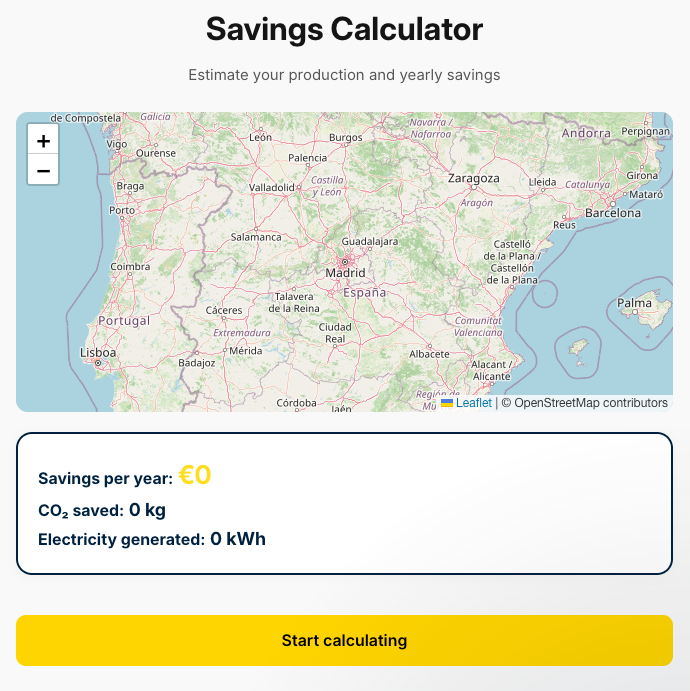
Savings Calculator

Estimate your production and yearly savings

Savings per year: €0

CO₂ saved: 0 kg

Electricity generated: 0 kWh

Find your Robinsun solar kit

Where will you install it?

Choose the mounting location for your kit.

How many panels?

Pick the kit size that fits your needs.

Disclaimer: In Spain, outputs above 800 W require grid certification (CIE) to export surplus. We can handle it for you.