Skip to content

Cart

Your cart is empty

Plugin solar in Greece

Yes. Since 14 September 2026, Greek rules explicitly allow households to use plug-in solar kits, often called balcony solar, under ministerial decision ΥΠΕΝ/ΔΑΠΕΕΚ/102876/1958. A kit may deliver up to 800 W from its micro-inverter, with up to 1,000 Wp of panels, and only one kit is allowed per electricity meter. You need no connection contract, permit or connection fee. You must notify the grid operator HEDNO (ΔΕΔΔΗΕ) online, and a licensed electrician must confirm your circuit meets HEDNO's safety specifications. The kit is for your own use: electricity that flows to the grid is not paid. Homes wired to the ELOT 60364 standard (from 2024) cannot connect a kit yet.

General overview for Greece

Plugin solar kits: 800 W

Allowed since 14 September 2026. The limits per meter are an 800 W micro-inverter (rated power, not software-limited), 1,000 Wp of panels and one kit. Plug it into a fixed Schuko socket; extension leads and power strips are not allowed. A licensed electrician checks the circuit and signs a declaration. Kits are not yet allowed on circuits built to ELOT 60364 (2024 onwards).

Other solar kits

Above the plug-in limits, you need a standard PV system installed by a professional. Households can install up to 10.8 kW per meter under the “Household PV” programme (Οικιακά Φωτοβολταϊκά). This goes through HEDNO's normal connection procedure and needs a telemetry meter. Batteries can be added to these systems.

Feed-in compensation

Plug-in kits are for self-consumption. Any surplus that flows into the grid is neither paid nor offset against your bill, so match the kit to your daytime base load or add a battery. A zero-export sensor is optional and must talk to the inverter wirelessly. Larger systems under net billing are paid for surplus at day-ahead market prices.

The legal basis for plugin solar in Greece

Plug-in solar was enabled by Law 5299/2026 (Government Gazette A' 67, May 2026), which transposed the EU renewables directive RED III. The detailed rules are in ministerial decision ΥΠΕΝ/ΔΑΠΕΕΚ/102876/1958 (Gazette B' 5573, 14 September 2026), issued by the Ministry of Environment and Energy (ΥΠΕΝ). It came into force on publication.

Article 2(19) defines “micro-solar systems with plug (plug-in)”: systems with or without storage, up to 800 W maximum power and 1,000 W installed power, installed in or on buildings solely to cover the owner's own consumption. The grid operator HEDNO published its special technical specifications (1st edition, 30 October 2026), covering equipment, installation and use, with or without batteries, in existing and new buildings.

One open point: the current national wiring standard ELOT 60364 (clause 551.7.2) does not yet allow plug-in generators on circuits built to it. ELOT opened a public consultation on an amendment on 30 October 2026, and HEDNO will update its specifications if the rule changes. This page is guidance, not legal advice.

Certification and registration requirements in Greece

Before installing, notify HEDNO through its dedicated online portal, logging in with your Taxisnet (tax portal) credentials. You enter your tax number and contact details, the installation address, your meter (supply) number, the kit's technical data, and the electrician's or engineer's details. HEDNO will announce the portal's start date by 31 December 2026. If you install before it opens, notify HEDNO within 30 days of launch. The shop can also pass your supply number to HEDNO when you buy.

Your home needs:

  • a valid installer's declaration (ΥΔΕ) for its wiring
  • a signed declaration from a licensed installer or engineer that HEDNO's specifications are met

Products must meet HEDNO's specifications:

  • micro-inverter certified to EN 62109 parts 1–3, with anti-islanding to EN 62116
  • leakage-current monitoring (RCMU) or a high-frequency transformer
  • AC disconnected within 0.1 s when unplugged
  • IP55 (IP44 for the plug)
  • assembly and user instructions in Greek

Batteries must be stationary lithium-ion with a battery management system, meeting EN IEC 62619 and IEC 62485-5.

How to handle your utility in Greece

  1. Check your wiring certificate. Confirm your home has a valid installer's declaration (ΥΔΕ); HEDNO has an online lookup (link below).
  2. Have a licensed electrician check the circuit. It needs a 30 mA residual-current device (RCD), type A and bidirectional unless the inverter maker states otherwise, plus a working earth and a Schuko socket. The electrician may swap a 16 A breaker for a 10 A one to prevent overheating. Any change affecting electrical safety needs a new declaration.
  3. Notify HEDNO through the online portal before you install.
  4. HEDNO handles the rest. It informs your electricity supplier, installs telemetry to record metering data, and may carry out spot checks.

HEDNO can name grid lines where new plug-in kits are not allowed for safety reasons, so check before buying. On non-interconnected islands, kits count towards the local system's capacity margin, but the operator cannot refuse them. Wiring-declaration lookup: HEDNO ΥΔΕ check.

Are there any incentives for plugin solar in Greece?

None currently. There is no dedicated subsidy or tax break for plug-in kits, and the rules explicitly waive the grid connection fee. Greek retailers list kits with standard 24% VAT.

Contribute to this overview

While we researched each country's regulation diligently, we might have missed a recent update or got something wrong. If you have more updated information, please contribute to this overview and message us.

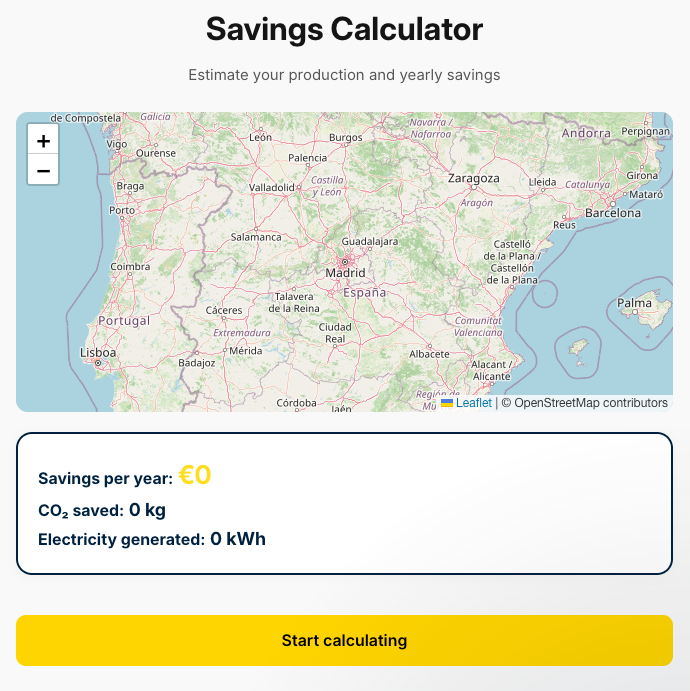
Savings Calculator

Estimate your production and yearly savings

Savings per year: €0

CO₂ saved: 0 kg

Electricity generated: 0 kWh

Find your Robinsun solar kit

Where will you install it?

Choose the mounting location for your kit.

How many panels?

Pick the kit size that fits your needs.

Disclaimer: In Spain, outputs above 800 W require grid certification (CIE) to export surplus. We can handle it for you.