Skip to content

Cart

Your cart is empty

Plugin solar in Cyprus

Can I use a plug-in solar kit in Cyprus? Not as a plug-and-play product, as of November 2026. Cyprus has no specific rule for plug-in or balcony solar, and no wattage below which you can skip the normal approval. Any solar system that connects to your home wiring and runs alongside the grid goes through the Electricity Authority of Cyprus (EAC) as distribution system operator. That means an application, installation by a licensed electrician and an inspection before switch-on. New systems connect under Net Billing, where surplus power earns much less than the power you buy. Kits used fully off-grid, for example to charge a portable power station, need no approval.

General overview for Cyprus

Plugin solar kits: None set

Cyprus has no specific plug-in rule, so there is no official watt limit for self-installed kits. Connecting a kit to a socket without EAC approval leaves an unapproved generator on your supply. Cyprus also uses UK-style BS 1363 (Type G) sockets, so most kits made for continental Europe come with the wrong plug. Using a kit off-grid is fine.

Other solar kits

Any grid-connected solar system, however small, follows the standard route:

  • a Net Billing application to the EAC distribution system operator (DSO)
  • a licensed electrician who installs and certifies the system
  • an EAC inspection

Homes with a single-phase supply can install up to 4.24 kW. Homes with a three-phase supply can install up to 10.4 kW.

Feed-in compensation

Since 1 January 2026, new home systems connect under Net Billing, set by the regulator CERA. You can sell surplus power through an agreement with your electricity supplier, join an aggregator, or choose not to export at all. Export earns a wholesale-based price, well below the retail price you pay. Output is often curtailed because Cyprus has no grid link to other countries.

The legal basis for plugin solar in Cyprus

Cyprus has no law or regulation that covers plug-in solar devices. Commission Recommendation (EU) 2026/1007 of 30 April 2026 asks member states to remove permits for balcony solar up to 800 W. It is not binding, and as of 9 November 2026 we found no Cypriot measure that implements it.

Small solar systems are governed by two sets of rules:

  • the Electricity Market Regulation Law (Law 130(I)/2021, as amended)
  • the self-consumption framework of the Cyprus Energy Regulatory Authority (CERA), Regulatory Decision 02/2024 (Official Gazette Κ.Δ.Π. 375/2024), as amended in 2025

The Energy Minister confirmed in 2026 that all new applications for self-consumption solar since 1 January 2026 are assessed under this CERA framework.

The technical rules come from the EAC distribution system operator (DSO). Its 2025 PV requirements set inverter and system size limits for homes, and its Net Billing technical guide sets the connection conditions. None of these documents contains a simplified route for kits connected to a socket. For questions, contact the EAC DSO or CERA directly. This page is guidance, not legal advice.

Certification and registration requirements in Cyprus

Cyprus has no product registry or notification form for plug-in kits. A grid-connected system is approved through the EAC DSO's Net Billing process instead:

  1. You apply to the EAC DSO for a Net Billing connection.
  2. A licensed electrician installs the system and signs the EAC readiness declaration (form Ε-ΔΔ-514) and a certificate of suitability (form ΗΜΥ 58).
  3. The system, including the inverter's grid protection, must meet the DSO's technical guide.
  4. You sign a contract with an electricity supplier, and the EAC then inspects the installation.

The forms are only available in Greek and are listed on the EAC's Electrical installation inspection page. Microinverters are allowed: systems up to 2.12 kW may use microinverters totalling 2 kVA if all DSO requirements are met. Ask your electrician which inverter certificates the DSO currently accepts.

How to handle your utility in Cyprus

The Electricity Authority of Cyprus runs the distribution network as DSO. It also still supplies electricity, but since 1 October 2025 other suppliers can compete for retail customers. In practice:

  • Talk to the EAC DSO before buying any grid-connected kit. It is the body that approves the connection.
  • Agree export terms with your supplier. After approval, your electricity supplier offers the agreement under which surplus power is credited. You can also choose not to export.
  • No extra production meter. Net Billing systems up to 10.4 kW do not need a separate production meter.
  • Expect curtailment on sunny days. The transmission system operator limits output from small solar systems when supply exceeds demand.

The EAC distribution helpline is 1800.

Are there any incentives for plugin solar in Cyprus?

  • VAT: since 16 October 2026, photovoltaic systems supplied to residential customers for self-consumption in their home are taxed at 9% instead of 19% (Decree Κ.Δ.Π. 363/2026). The Tax Department has not yet said whether small kits qualify.
  • Income tax: from 2026, you can deduct up to €1,000 per taxpayer for green investments in your main residence, including renewable systems and batteries. Family income limits apply.
  • Grants: the €1,500 home solar grant closed on 31 December 2025. A home battery subsidy has been announced, but we found no open call as of 9 November 2026.

Contribute to this overview

While we researched each country's regulation diligently, we might have missed a recent update or got something wrong. If you have more updated information, please contribute to this overview and message us.

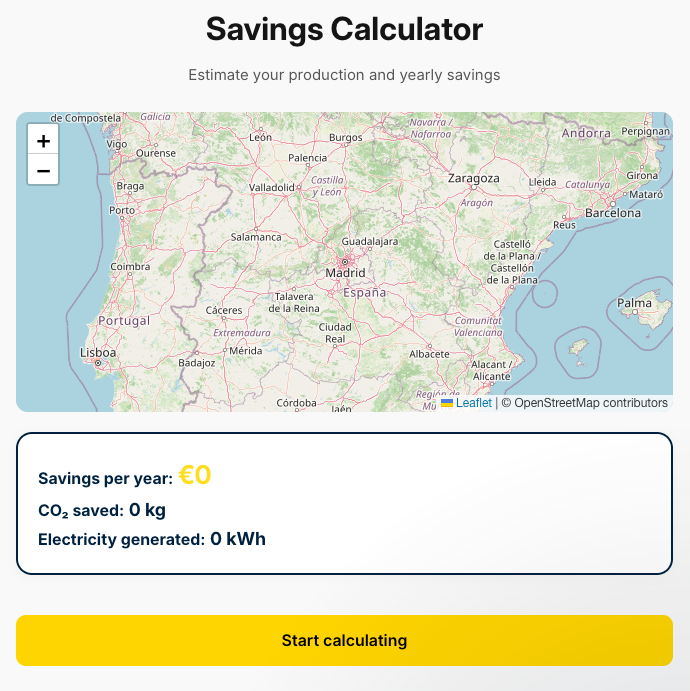
Savings Calculator

Estimate your production and yearly savings

Savings per year: €0

CO₂ saved: 0 kg

Electricity generated: 0 kWh

Find your Robinsun solar kit

Where will you install it?

Choose the mounting location for your kit.

How many panels?

Pick the kit size that fits your needs.

Disclaimer: In Spain, outputs above 800 W require grid certification (CIE) to export surplus. We can handle it for you.