Skip to content

Cart

Your cart is empty

Plugin solar in Bulgaria

Can I use a plug-in solar kit in Bulgaria? Not as a simple plug-in device: Bulgaria has no specific rule for plug-in or balcony solar, and no national watt limit. Small solar systems for your own use follow the general self-consumption route. You notify your grid operator, who sets zero-export wiring requirements, and you usually need design documents from a licensed designer. Houses up to 20 kW are exempt from a building permit. Apartments are not, and need the building owners' consent. Surplus power fed to the grid is not paid. Campaigners are calling for simpler rules, so check back for updates. This page explains the rules, the paperwork, dealing with your grid operator and current incentives.

General overview for Bulgaria

Plugin solar kits: None set

Bulgarian law does not recognise plug-in solar as a separate category, and there is no 800 W allowance. A kit plugged into a socket is treated like any other solar installation for self-consumption. The EU Recommendation of April 2026, which asks countries to drop permits for balcony solar up to 800 W, is not binding and has not been adopted in Bulgaria.

Other solar kits

Kits above 800 W follow the same route as smaller ones: a notice to the grid operator and zero export, up to twice your contracted grid capacity. There is no rule on sockets either way. Single-family and holiday homes up to 20 kW notify the municipality's chief architect, with design documents from licensed designers, instead of applying for a building permit. Flats need a building permit.

Feed-in compensation

Under the self-consumption route, no power may flow to the grid, and the grid operator sets wiring requirements to prevent it. Bulgaria has no net metering. Selling surplus means connecting as a producer through a separate, longer procedure. Preferential prices for new small rooftop systems are being abolished (law passed 6 November 2026).

The legal basis for plugin solar in Bulgaria

Bulgaria has no law or regulation specific to plug-in solar. Three laws apply instead.

  • Renewable Energy Act (ZEVI), Art. 25a: self-consumption systems can be built on the roofs and facades of buildings already connected to the grid in urban areas, with total capacity up to twice the contracted capacity and no more than 5 MW.
  • Spatial Development Act (ZUT), Art. 151(1)(19): no building permit for solar up to 20 kW for self-consumption, but only on single-family homes and holiday houses and their plots. A flat in an apartment block is not covered.
  • Condominium Act: balconies and facades are common parts of the building.

Grid connection is governed by Ordinance No. 6 of 28 March 2024. It does not reflect the 0.8 kW threshold in EU Regulation 2016/631, so micro systems have no simplified procedure. A 2025 Ministry of Energy consultation discussed exempting systems up to 0.8 kW, but no such rule has been adopted. Parliament passed further ZEVI amendments on 6 November 2026; they take effect once published in the State Gazette. This page is guidance, not legal advice.

Certification and registration requirements in Bulgaria

There is no product register or registration specific to plug-in kits. Under Art. 25a ZEVI, the customer files a notice with the grid operator using the operator's own form: ERM Zapad (west), Elektrorazpredelenie Yug (south) or Elektrorazpredelenie Sever (form 168) (north-east). The form asks for capacity, single- or three-phase inverter and your customer number, and you declare the power is for self-consumption only.

For houses up to 20 kW, you notify the municipal chief architect up to 14 days before installation, with structural and electrical design solutions by licensed designers. Within 14 days after installation, owner and installer send a joint declaration to the chief architect and the grid operator. Choose inverters certified to EN 50549-1, with anti-islanding protection and an export-limiting function.

How to handle your utility in Bulgaria

Talk to your grid operator before you plug anything in. After your Art. 25a notice, the operator provides, within 14 days, an annex to your grid access contract with the technical wiring requirements so that no power flows into the grid. No connection opinion is issued on this route.

The choice is hard to reverse: if you later want to export surplus, you must start the full producer connection procedure from scratch (Art. 25a(5) ZEVI).

Check your meter. Bulgaria has no net metering, and press reports say an unadjusted meter may record power sent back to the grid as consumption, so you could be billed for it. Ask your operator how your meter handles reverse flow. Size the system to your daytime base load, and use export limiting.

Are there any incentives for plugin solar in Bulgaria?

None currently. There is no subsidy, tax deduction or reduced VAT for plug-in kits; Bulgaria applies its standard 20% VAT rate to solar equipment. The household solar programme under the Recovery and Resilience Plan (BG-RRP-4.026) covered rooftop systems, and its targets were cut in May 2026. Preferential buy-back prices for new rooftop systems up to 30 kW end once the November 2026 ZEVI amendment is published.

Contribute to this overview

While we researched each country's regulation diligently, we might have missed a recent update or got something wrong. If you have more updated information, please contribute to this overview and message us.

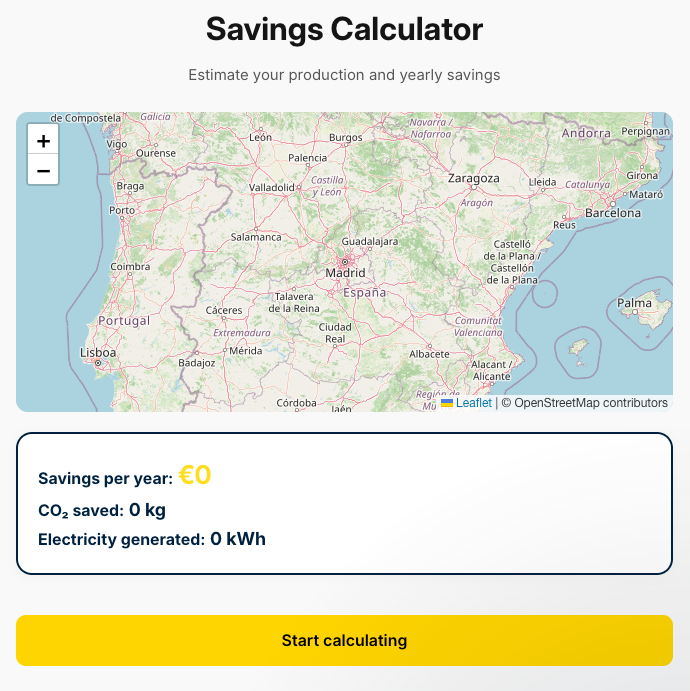
Savings Calculator

Estimate your production and yearly savings

Savings per year: €0

CO₂ saved: 0 kg

Electricity generated: 0 kWh

Find your Robinsun solar kit

Where will you install it?

Choose the mounting location for your kit.

How many panels?

Pick the kit size that fits your needs.

Disclaimer: In Spain, outputs above 800 W require grid certification (CIE) to export surplus. We can handle it for you.